
Chapter 3 of NavPers 10797-A, Naval Ordnance and Gunnery, Volume 1 is the most comprehensive chapter on naval ammunition in the text. It classifies all types of naval ammunition, then examines each major component in detail: propelling charges (bag and case), primers, projectiles (armor-piercing, high-capacity, antiaircraft, special-purpose), fuzes (point detonating, base detonating, time, and VT proximity), tracers, and aerial bombs. Figures throughout illustrate key components as used in U.S. Navy service during the mid-20th century.
A. General
3A1. Definitions
Ammunition is the complete assemblage of the component parts, or ammunition details, which, together, make up a charge or round for any type of weapon.
Ammunition details include primers, boosters, detonators, powder, powder bags, cases, fuzes, projectiles, etc.
3A2. Classification of ammunition
Ammunition is classified by type stowage. The classification consists of the following types: gun ammunition; bomb-type ammunition; rocket-type ammunition; guided missiles; pyrotechnics; chemical ammunition; demolition material; and miscellaneous.
3A3. Gun ammunition
Gun ammunition comprises 4 types: bag, semifixed, fixed, and small arms. The distinction between the first 3 depends on the manner in which the charges are assembled. In bag ammunition, the primer, propelling charge, and projectile are separate units. In semifixed ammunition, the primer and propelling charge are contained in one unit, while the projectile is separate. In fixed ammunition, all 3 components are assembled in 1 unit.
3A4. Bomb-type ammunition
Bomb-type ammunition is characterized by thin-walled containers, loaded with relatively large bursting charges. This ammunition depends for its effect upon the destructive blast of the explosive, rather than any penetrating qualities of the container. Included in the group are torpedo warheads, mines, depth charges, and some aircraft bombs.
3A5. Rocket ammunition
A rocket consists essentially of a head and a motor. The head may be solid or may contain a bursting charge. The motor contains fuel, either in the form of a large grain of powder or a liquid. The burning of the fuel releases the energy necessary for propulsion. To stabilize its flight, the rocket either has fins on its after end, or is made to spin by exhausting the motor gases through canted nozzles.
3A6. Guided missiles
A guided missile is an unmanned vehicle moving above the earth's surface, whose trajectory or flight path is capable of being altered by mechanisms within the vehicle. Guided missiles include, besides such control mechanisms, explosive warheads and power plants, usually of the rocket or jet type.
3A7. Pyrotechnic ammunition
Pyrotechnic ammunition may be classified according to use into three types: (1) Signaling, (2) Illuminating, and (3) Marking. Pyrotechnic materials are mixtures of oxidizing agents and combustibles (powders such as magnesium and chlorate mixtures) to which other compounds may be added for such particular purposes as to color the flame or smoke.
3A8. Chemical ammunition
Included under this classification are all projectiles, bombs, grenades, candles, or other containers of compounds the purpose of which is to produce, when liberated, gas, smoke, or fire. Also, free fluids or gases released from aircraft tanks, projectors, or sprayers are designated as chemical agents.
Chemical ammunition may be designated according to the type of container, as projectile, bomb, or grenade. However, the more usual classification, and the one used for storage purposes, is according to the nature of the filling: Group A — persistent vesicants (mustard gas, lewisite); Group A-1 — nonpersistent lethal gases (phosgene); Group B — lacrimators and smokes (CH, FM, FS); Group C — spontaneously inflammable agents such as WP (white phosphorus); Group D — readily inflammable mixtures such as TH (thermite).
3A9. Demolition material
Explosives intended for such uses as blasting, eliminating hazards to navigation and obstacles to amphibious landing, and destroying gear to prevent capture by the enemy, comprise demolition material. Half-pound demolition charge blocks, consisting of either pressed TNT or cast TNT and tetryl, are issued to ships for general use. Large demolition charges, also consisting of TNT, and assembled with half-pound booster charges, are also issued for major projects, such as scuttling vessels.
3A10. Shaped charges
Relatively small quantities of explosive known as shaped charges can be made to pierce heavy steel plate by employing them as shaped charges which direct the explosive force into a small and concentrated jet.
In an ordinary bursting charge the expanding detonation wave proceeds outward from the point of detonation, producing stresses on all portions of the enclosing case. In a shaped charge (fig. 3A1), a portion of the case farthest from the detonator is in the form of a regular cavity (usually a cone, hemisphere, or V-shaped groove) so that the detonation wave fronts impinging progressively over that portion of the case will cause compression toward the center of the cavity. The front of this jet is composed of a large number of gaseous metallic particles moving at speeds of 20,000 to 30,000 feet per second. A well-designed shaped charge will penetrate armor up to three times the diameter of the cone.
One important factor in the effectiveness of a shaped charge is the distance of the charge from the target surface at the instant of detonation. This distance, called stand-off distance, is necessary to permit effective focusing of the gaseous jet. In general the stand-off distance at the time of detonation should equal the diameter of the shaped-charge cone.

3A11. Miscellaneous types
Under this heading are grouped a variety of types for special purposes such as impulse ammunition, blank ammunition, trench warfare ammunition, and dummy ammunition. An impulse charge is a propelling charge designed to project a missile a short distance. Blank ammunition contains no projectile but consists of a cartridge case with primer and powder charge. Dummy ammunition includes any type of ammunition or any ammunition detail assembled without explosives, used for training and test.
B. Propelling Charge
3B1. Gun ammunition
Propelling charges with their containers, primers, projectiles, and projectile fuzes are the major components of a complete round of gun ammunition, whether bag, semifixed, or fixed. Each of the many naval guns is provided with its own associated ammunition, designed in normal service use to impart to its projectile a specified velocity at the muzzle called initial velocity (abbreviated I.V.). Figure 3B1 shows typical rounds.

3B2. Bag ammunition
In bag ammunition the propelling charge is a separate unit. Large guns require large quantities of propellent powder to attain required projectile initial velocity. By packing the powder grains in fabric bags, it is possible to divide the charge into units each of which can be expeditiously handled by one man. Bag charges are used in the United States Navy at the present time in some 8-inch guns and all guns larger than 8-inch. The largest guns in present use, the 16"/50 caliber on the newest battleships, use six powder bags with each projectile.
3B3. Powder bags
The material used for powder bags is silk, because only this fabric will completely burn away when combustion of the charge takes place, leaving no smoldering residue to cause the premature explosion of the next charge loaded. Each bag is roughly cylindrical in shape. One end consists of an ignition pad containing black powder quilted into the fabric so as to keep the black powder evenly spread throughout the pad. Light-weight cloth, dyed red, is used for the ignition pad.
The firing of the separate primer used with bag guns can be relied on to set off the black powder in the ignition pad, but may not be sufficiently potent to initiate combustion of the smokeless powder grains directly. It is essential, therefore, that each bag of a charge be loaded into the gun with the ignition pad aft, facing the breech plug and within a few inches of the next bag or of the breech plug and primer.

3B4. Powder tanks
Storage of smokeless powder must be both airtight and watertight if standard performance is to be maintained. Since powder bags are neither airtight nor watertight, they are stored in tanks. These powder tanks are important pieces of ordnance equipment which must be properly maintained. Leaky tanks admit moisture and air and allow ether and alcohol volatiles to escape. Tanks for powder bags contain wooden spacers to prevent building of a static charge which might ignite the powder by a spark.
C. Primers
3C1. General
A primer is a device used to initiate a flame for the ultimate purpose of igniting a charge of propellant. In bag ammunition this flame is applied to the ignition pad (the auxiliary ignition charge) in the base of the powder bag, which in turn ignites the smokeless powder. In case ammunition the ignition charge is incorporated into the primer tube. Since the ignition charge incorporated in the bag can be proportional in size to the charge, the primers are the same for bag guns of all sizes. However, primers of different sizes must be used in cases of different sizes so that the amount of black powder in the primer may be proportional to the amount of propellant.
3C2. Types and classes of primers
Primers are divided into two types, depending on how they are used in the gun: (1) case and (2) lock. They are also divided into three classes, depending upon the method of firing: (1) percussion, (2) electric, and (3) combination. Percussion primers are fired by the mechanical impact of a firing pin. Electric primers are fired by passing a current through a resistance filament surrounded by an initiating mixture. Combination primers may be fired by either method. The current trend is toward the use of electric primers only, in case guns of 3-inch and larger caliber. The following service primers are in current use: case percussion primer; case electric primer; case combination primer; lock combination primer.
3C3. Case percussion primer
This type is used in light and heavy machine guns such as the 20- and 40-mm. In ammunition for the smaller guns, which has a relatively small amount of propellant, the primer consists only of a cap, an anvil, and a percussion-sensitive mixture. In operation, the firing pin strikes the inverted cup which holds the primer cap. This indents the cup, forcing the cap against the anvil and exploding the pellet of initiating mixture. The resulting flame ignites the propellant. Where greater energy is required to ignite the propellant, the primer includes a black-powder charge which is ignited by the percussion cap. See figure 3C1.

3C4. Case electric primer
Case electric primers (fig. 3C2) are used for the newer 3-, 5-, 6-, and 8-inch guns. These primers contain an electric ignition element which consists of two resistance filaments connected in parallel and surrounded by an explosive mixture, and a small black-powder primer charge. An electric current heats the filaments, which then ignite the explosive mixture. Flame from the initiating mixture ignites the black-powder primer charge, which in turn ignites the main black-powder charge of the primer.

3C5. Case combination primer
This type of primer is used in the 5"/38 caliber and the older 5"/54 and 6"/47 caliber guns. It is also used in clearing charges for all case guns of 3-inch caliber and larger. These primers can be fired either by percussion or electrically. Electrical firing is considered the primary method; the percussion feature is a standby for use in the event that electric firing fails. The percussion element is similar to that of the case percussion primer, except that the firing pin strikes a plunger which in turn explodes the cap against the anvil. The flames produced by the primer cap act directly upon the powder in the electric ignition cup. See figure 3C3.
The electric element consists of a high-resistance wire wrapped in a wisp of guncotton and contained in a mixture of pulverized guncotton and fine black powder in the ignition cup. This wire is connected at one end to the percussion plunger group, which is insulated from the primer stock. The other end of the wire is grounded through the primer stock and the cartridge case to the metal of the gun. In firing, an electric current is passed through the firing pin to the plunger, heating the bridge wire, igniting the wisp of guncotton, and the mixture in the ignition cup fires the black-powder primer charge.

3C6. Lock combination primer
The same type and size of primer (fig. 3C4) is used in all United States Navy bag guns. A primer is placed by hand in the firing lock of the gun each time the gun is loaded. There is no ignition charge in the primer, as one is included in the assembled powder bag. The percussion and electric features of the lock combination primer are the same as those of the case combination primer.

D. Projectiles
3D1. General
The projectile is that part of a round of gun ammunition which is expelled from the gun by the force of the explosion of the propelling charge. Present-day projectiles are elongated cylinders with a pointed front end. The application of the principle of rifling to guns caused the abandonment of the earlier spherical projectile. Rotation of the projectile permitted the use of a longer and heavier projectile, thus obtaining vastly increased range, accuracy, penetrative ability, and sectional density.
Modern small-arms projectiles often consist of solid metal; projectiles used in larger guns, however, are assemblies of several components. The three essential parts are the metallic body, the explosive bursting charge, and the fuze which sets off that charge. There may also be a tracer to make the projectile more readily visible during flight.

3D2. Projectile bodies
The solid bullet damages by impact alone. Assembled projectiles, however, inflict damage primarily by the blast of the high-explosive charge and the resulting high-velocity fragments. The external shape of the projectile is designed to obtain the desired flight characteristics of stability and minimum air resistance. The form of forward end which best fulfills these conditions is the ogive — the shape generated by the revolution of an arc of a circle about a chord. In a projectile the chord is the axis of the projectile and the radius used is about nine times the diameter (caliber) of the projectile.
Abaft the ogive a projectile is cylindrical. The cylindrical shape may continue to the base (square base) or the after portion may be slightly tapered (boat-tailed). Near the after end of the cylindrical part of the projectile is the rotating band; at the forward end is the bourrelet. These two surfaces, slightly raised above the body, provide the support and bearing which steady the projectile in its passage through the gun. See figure 3D2.

3D3. The bourrelet
The forward bearing surface of a projectile is machined to a fine finish to reduce friction and minimize the wear of the gun. In small projectiles the entire body forward of the rotating band may be finished to bourrelet diameter. On large-caliber projectiles additional bourrelets, abaft and forward of the rotating band, are added to provide better support, especially during ejection from the muzzle. Standard United States Navy practice requires a specified bourrelet diameter 0.015 to 0.023 inch (in different-caliber projectiles) smaller than the diameter of the bore.
3D4. Rotating band
The three primary functions of the rotating band are to seal the bore, to position and center the rear end of the projectile, and to impart rotation to the projectile. Its secondary function is to hold the projectile in its proper position in the gun after loading and ramming, and to ensure that it will not slip back when the gun is elevated. Rotating bands are usually made of fine copper; in major-caliber projectiles a small percentage of nickel is added to provide greater strength. Some projectiles of recent design have been banded with gilding metal (90 percent copper, 10 percent zinc), which increases strength and reduces the amount of copper deposited in the bore of the gun.
3D5. Weight of projectiles
Within reasonable limits, a gun can fire projectiles of varying weights. Approximate weights of United States Navy projectiles are determined by the formula W = d³/2, in which W = weight of projectile in pounds, and d = caliber of gun in inches. The weight of the projectile per square inch of bore is called sectional density: SD = W/A, where A = area of bore, including grooves, in square inches.
3D6. Classification of projectiles
All gun projectiles, other than small arms, share the characteristics thus far described, but since targets differ in character, projectiles must differ in design, the better to defeat them. The primary classification is into three general types: (1) Penetrating, (2) Fragmenting, and (3) Special-purpose.
3D7. Penetrating projectiles
This type includes armor-piercing (AP) and common (Com). They are designed to penetrate, respectively, heavy and light armor. The usual bursting charge for these types is Explosive D, which is insensitive enough to permit penetration without premature detonation.
3D8. Fragmenting projectiles
These projectiles are designed to inflict damage both by blast effect and by fragmentation — breaking up into small high-velocity fragments. They are characterized by thin walls and large cavities for the explosive filler.
1. High-capacity (HC) projectiles (fig. 3D3) are used against unarmored surface targets, shore objectives, or personnel. Since no penetration ability is required, explosives more sensitive than Explosive D may be used.
2. Antiaircraft (AA) projectiles are designed for use against airplanes in flight. Except for fusing they are substantially the same as high-capacity in the larger calibers.
3. Antiaircraft common (AAC) projectiles are a dual-purpose design, combining the qualities of antiaircraft projectiles with the toughness necessary to penetrate steel plating not of armor thickness.

3D9. Special-purpose projectiles
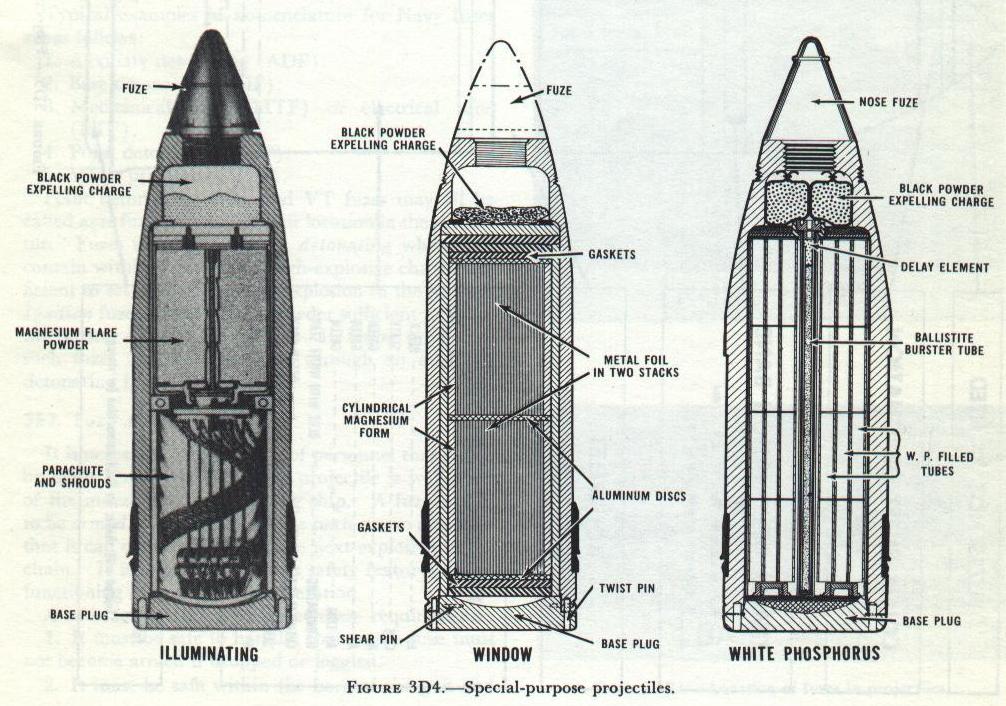
These are not intended to inflict damage by explosion or by fragmentation. Their construction incorporates no strength other than that required to withstand discharge from the gun without damage to the contents. See figure 3D4. Some of the common varieties are:
1. Illuminating (Illum) projectiles, often called star shells (SS), contain a bright flare attached to a parachute. As the parachute slowly lowers the flare, it serves to illuminate the target.
2. Smoke, or white phosphorus (WP), projectiles contain tubes of that substance which are scattered and burst by a small black-powder charge. White phosphorus produces a screening smoke and has some incendiary effect.
3. Window (W) projectiles contain metal foil strips, which, when scattered high in the air by the small burster charge, serve to confuse enemy radar operators.
4. Non-fragmenting projectiles are used for antiaircraft gun practices. They contain a smoke-producing substance, available in various colors, which makes it possible to observe the bursts without close bursts destroying the target.
5. Target or blind-loaded (BL) projectiles contain an inert substance, often sand, designed to give the same weight and balance characteristics as explosive fillers, used for training and test.
6. Proof-shot projectiles are used for proof tests of guns at the proving ground.
3D10. Dye loads
Penetrating projectiles designed primarily for use against surface targets usually contain small quantities of dye, so placed in the nose of the projectile as to be dispersed upon water impact. This dye colors the splash produced by the hit and thus allows a ship to identify its own splashes. Standard practice is to issue to each ship in a division its own identifying color. Available colors are red, blue, green, and orange.
3D11. Projectile markings
Projectiles are painted various colors to facilitate rapid identification by gun crews. Nose fuzes and rotating bands are never covered with paint. Bourrelets are covered with one thin coat of paint only, and may never be repainted or retouched. The remainder of the projectile is painted according to the code set forth in figure 3D5, which applies to all calibers larger than 40-mm.

E. Fuzes and Tracers
3E1. General
A projectile fuze is a mechanical, electrical, electronic, magnetic (or combination) device which will detonate or ignite a charge in a projectile at the time and under the circumstances desired. Fuzes may be classified according to function (impact, time, or proximity), the position of the fuze in the projectile (nose or base), type of mechanism (mechanical or VT), and specific action at time of functioning (ignition or detonation). Figure 3E1 illustrates typical fuzes.
Typical examples of nomenclature for Navy fuzes are as follows: Auxiliary detonating (ADF); Base detonating (BDF); Mechanical time (MTF) or electrical time (ETF); Point detonating (PDF); VT or proximity (VTF).
Point detonating, time, and VT fuzes may all be called nose fuzes because of their location in the projectile. Fuzes are designated as detonating when they contain within themselves a high-explosive charge sufficient to set off a high-order explosion in the burster. Ignition fuzes contain black powder sufficient to ignite the burster of small projectiles.

3E2. Fuze safety
It is necessary for the safety of personnel that a fuze be made inoperative until the projectile is well clear of the muzzle and of the firing ship. A fuze is said to be armed when its component parts are so arranged that it can operate to set off the next explosive in the chain. It is unarmed when its safety features are so functioning as to prevent its operation. A satisfactory fuze must be safe to handle, safe within the bore of the gun and for a sufficient distance outside to ensure security of personnel in the vicinity, and must initiate the explosion of the filler at the proper moment.
3E3. Fuze operation terminology
If fuzes were not equipped with safety features, they would be relatively simple. Forces which may be used to operate fuzes are:
1. Setback. The force of inertia which tends to move all fuze parts to the rear as the projectile is initially accelerated in the bore of the gun.
2. Angular setback. The force of inertia, which tends to resist the initial rotational acceleration of the projectile in the gun.
3. Centrifugal force. The continuous force, caused by the rotation of the projectile in flight, which tends to move all fuze parts radially away from the axis of the projectile.
4. Creep. The continuing inertial force resulting from the deceleration of the projectile in flight, caused by air resistance, which tends to move forward the fuze parts not exposed to the air.
5. Impact. The sudden inertia force which tends to move all fuze parts forward when a projectile strikes.
6. Target contact. The rearward movement of a firing plunger or other device when the projectile contacts the target material.
The magnitude of some of these forces is illustrated in the table below.

3E4. Auxiliary detonating fuzes
"Aux dets" are used in conjunction with all types of nose fuzes in HC, AA, and AAC projectiles of 3-inch and greater caliber. They are interposed between the nose fuze and the bursting charge of the projectile to provide a heavier shock for detonating the bursting charge. They also act as a safety feature, preventing the projectile filler from exploding in case the nose fuze should be accidentally actuated prior to the arming of the auxiliary detonating fuze.
3E5. Base detonating fuzes
Base fuzes are used alone in armor-piercing and common projectiles. They are used in combination with nose fuzes in such dual-purpose projectiles as AAC and HC. All base detonating fuzes function on impact; some, however, incorporate a delay feature. Base detonating delay fuzes function a short time (0.02 to 0.033 second) after the projectile hits the target, thus allowing time for armor penetration. Base detonating non-delay fuzes contain no actual delay element, but a slight inherent mechanical delay provides a time margin sufficient for the penetration of thin sheet metal.
3E6. Time fuzes
In most calibers of gun projectiles, time fuzes are clockwork mechanisms used to obtain timed air bursts. They are used in AA, AAC, AA (non-frag), HC, Illum, WP, and W projectiles of 3- to 6-inch sizes and in HC projectiles of 8- to 16-inch caliber. There are two general types of mechanical time fuzes: one type depends for its action solely upon centrifugal force; the other is a spring-driven variety. The centrifugal type is less affected by long periods of storage, but the spring-driven fuzes are more satisfactory for use on large projectiles which have slower speeds of rotation.
3E7. Point detonating fuzes
Point detonating fuzes are designed to function on impact with the target. They have the advantage of being faster acting on impact than base detonating fuzes. One group of such fuzes is used in place of mechanical time fuzes in connection with shore bombardment with HC, AAC, and WP projectiles. Other marks of point detonating fuzes are used in 20- and 40-mm projectiles.
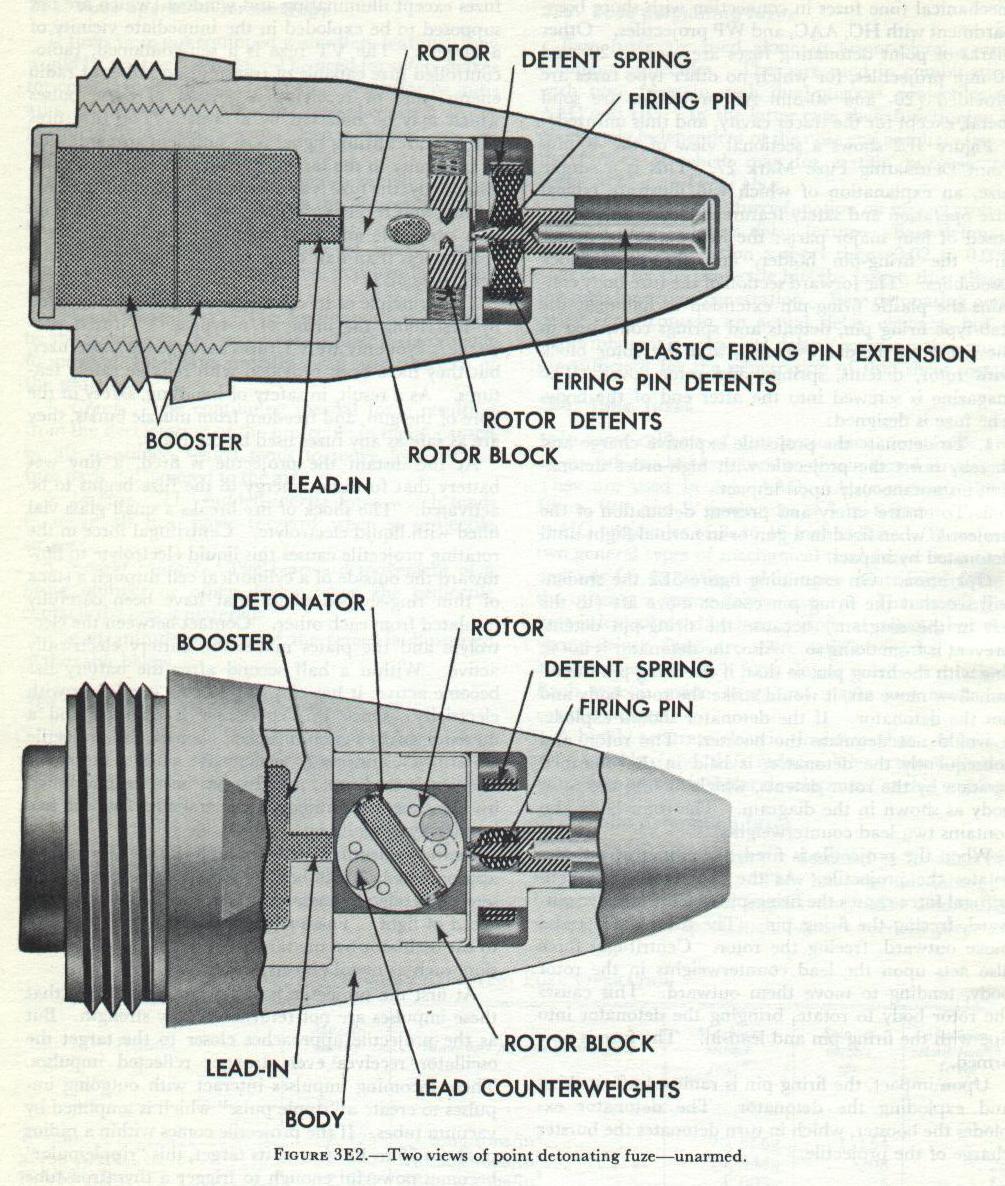
Figure 3E2 shows a sectional view of the 40-mm Point Detonating Fuze Mark 27. The fuze is composed of four major parts: the fuze body, the magazine, the firing-pin holder, and the rotor block assemblies. When the projectile is fired, the rifling in the gun rotates the projectile. As the projectile spins, centrifugal force causes the firing-pin detents to move outward, freeing the firing pin. The rotor detents also move outward, freeing the rotor. Centrifugal force also acts upon the lead counterweights in the rotor body, causing the rotor body to rotate, bringing the detonator into line with the firing pin. The fuze is now armed. Upon impact, the firing pin is rammed aft, striking and exploding the detonator.
3E8. VT fuzes
The radio proximity or VT fuze is used in all of the types of projectiles which can use mechanical time fuzes except illuminating and window. The VT fuze is a self-contained, radio-controlled fuze capable of transmitting pulses of radio energy, and of receiving a portion of these pulses which may be reflected by a target. The fuze fires when the returning signal is of sufficient strength, due to proximity to the target, to trigger the firing circuit. Essentially, the fuze is an extremely rugged radio transmitting and receiving station, which fits into the nose of a projectile and is so compact that it displaces a volume less than half of an ordinary pint milk bottle. See figure 3E3.
At the instant the projectile is fired, a tiny wet battery begins to be activated: the shock of fire breaks a small glass vial filled with liquid electrolyte; centrifugal force causes the liquid to activate the battery. Once charged, a mercury safety switch opens, the projectile is "armed," and ready to detonate when a target influences it to do so — all within the first few hundred yards of flight.
As the projectile approaches the target, reflected radio impulses interact with outgoing impulses to create a "ripple pulse" which is amplified by vacuum tubes. If the projectile comes within about 75 to 100 feet of its target, this pulse becomes powerful enough to trigger a thyratron tube which acts as an electronic switch, releasing the stored electrical energy and operating an electrical primer, which sets off the main explosive charge.
VT-fuzed ammunition is very effective on exposed personnel and lightly armored targets ashore. It is also well adapted for harassing and interdiction fire. No matter what the topographic configuration, the fuze will detonate at that designed point in its flight in close proximity to a reflecting mass, where fragmentation blankets a maximum effective area.

3E9. Tracers
It is sometimes advantageous to follow a projectile in flight. For this purpose a tracer body is installed in the base or as an extension to the base, of the projectile. It contains a pyrotechnic mixture designed to burn with a definite color during all or a specific part of the projectile's flight. Standard tracer colors in the Navy are red or white in AA projectiles and orange (for night tracers) in AP and common projectiles. The tracer is ignited by the heat or pressure of the propelling charge.
In 40-mm projectiles, tracers perform the special function of setting off the burster charge at the end of the tracer burning period. This is accomplished simply by allowing the inside end of the tracer to have direct access to the main charge. The advantage of a self-destructive feature in AA projectiles, which might otherwise land and burst on own ships or installations, is obvious.
F. Bombs
3F1. Bombs and bomb components
The aerial bomb provides for very efficient use of the load-carrying ability of a given plane. Only a small fraction of the weight involved must be reserved for suspension, release, and sighting equipment. A conventional aerial bomb has three major components: the body, which contains the explosive charge or chemical filler; the fin assembly, provided to keep the bomb stable in flight; and a fuze which serves to detonate the charge.
3F2. Bomb classification
In terms of their fillers there are three general types of bombs: explosive bombs, chemical bombs, and inert bombs. Varieties of explosive bombs include armor-piercing, semi-armor-piercing, general-purpose, light-case, depth, fragmentation, and antiaircraft types. Chemical bombs include gas, smoke, and incendiary varieties. Inert bombs contain no explosives or chemicals, and are used in drills and in practice bombing. A number of aerial bombs are shown in figure 3F1.

3F3. Explosive bomb types
Armor-piercing bombs (fig. 3F2) are thick walled, contain about 15 percent by weight of explosive filler, and are intended for use against heavily armored ships and heavy steel or concrete structures. They incorporate only tail fuzes. If used against unarmored or lightly armored ships, they are likely to pass clear through the target before detonating.

General-purpose bombs (fig. 3F3) have medium-thick cases, contain about 50 percent by weight of explosive filler, and are used to produce blast, fragmentation, or mining effects. Appropriate targets include unarmored vessels, submarines, and land targets such as ordinary buildings, aircraft (on ground), gun emplacements, and personnel.
Light-case bombs carry a maximum explosive charge: about 75.6 percent by weight. The fuzes used function instantaneously; this is necessary, because cases rupture upon impact. Their effect depends largely upon blast and, to a lesser degree, upon fragmentation.
Depth bombs, intended primarily for attacks upon submarines, contain about 70 percent by weight of explosive filler, and have relatively light cases. A depth bomb has a flat nose to reduce the possibility of ricochets when dropped into the water at small entrance angles. For attacks upon submarines, this bomb is fitted with a hydrostatic tail fuze.
Fragmentation bombs have heavy cases made up of steel rings or steel bars, and contain about 14 percent by weight of explosive charge. When such a bomb bursts, fragments from the shattered case are thrown outward at high velocity and may do considerable damage to light installations, aircraft on the ground, unarmored vehicles, and personnel.

3F4. Fire and incendiary bombs
Fire and incendiary bombs are types of chemical bombs. Large fire bombs may be droppable fuel tanks filled with a highly flammable mixture, which is usually 94 percent of 80 or 100 octane gasoline and 6 percent napalm. Napalm thickeners gel the gasoline to a rubbery mass of such a consistency that when used in the fire bomb the resulting conflagration covers a large area, burns intensely, and lasts a long time. The average coverage from one bomb dropped on level terrain is about 300 feet long and 100 feet wide, when dropped from aircraft in level flight at altitudes of 100 feet and speeds of 300 knots.
As an antipersonnel weapon, the fire bomb has been found to be effective against personnel in slit trenches, dugouts, and foxholes. As an incendiary, it is effective against wooden piers, houses, docks and waterfront warehouses, wooden surface vessels, ammunition dumps, truck convoys, and any other readily burnable target.
Other incendiary bombs usually contain thermite in magnesium alloy cases. As the thermite burns, the magnesium case becomes ignited and adds to the incendiary effect.